Why Traditional Flow Tests Discharge Water, and What That Means for Your Building
October 6, 2026Ask anyone who has stood in a riser room during a quarterly inspection, and they’ll describe the same sequence. A valve opens, water runs to a drain, and a moment later the alarm sounds. It looks wasteful, and in an occupied building it can feel like a lot of coordination for one alarm signal.
There’s a good engineering reason behind it. A flow switch only reacts to moving water, and water in a wet-pipe sprinkler system sits still until something gives it a path. That is why traditional flow tests discharge water: the test has to create real flow past the switch, and the only way to do that is to let water out of the system. At Zonecheck USA, we work with this problem every day, so we’ll walk through what’s happening in the pipe, what the discharge costs, and where a different approach fits.
What Is a Flow Switch Actually Detecting?
A waterflow switch is a paddle, or vane, that sits inside the sprinkler pipe. When water moves past it, the paddle deflects, and the switch signals the fire alarm panel. Many switches include a retard or delay feature, so a brief pressure surge doesn’t trigger a false alarm. The switch has to see flow that’s sustained, not just a flicker.
That detail explains a lot. A full pipe under pressure isn’t enough to move the paddle. The water has to travel, and it has to keep traveling long enough to satisfy the delay.
How Does a Traditional Flow Test Create That Flow?
In a real fire, an open sprinkler head lets water out, pressure drops, and water rushes toward the opening. A traditional test copies that on purpose:
- The team notifies occupants and the alarm monitoring company.
- The technician opens the drain or test connection on the zone being tested.
- Water leaves the zone, pressure drops, and water moves along the pipe.
- The moving water deflects the flow switch paddle.
- After sustained flow, the switch sends its signal to the panel.
- The technician confirms the signal was received, closes the valve, and returns the system to normal.
Test connections are generally sized to imitate a single sprinkler operating. That’s what makes the result meaningful, since the switch is being asked to respond to the kind of flow it would see in an actual event. It also means water keeps leaving the system for as long as the flow is held.
Why Do Traditional Flow Tests Discharge Water Instead of Using a Simulation?
Because the older method tests the switch under the same physical conditions it faces in service, and it has been the accepted approach for decades. Nothing about the switch can be proven without flow, and in a conventional layout the only outlet is the drain. In our view, that history is the real reason the discharge feels normal. Few people question a routine that has always worked, even when its side effects are well known.
What Does a Flow Test Prove, and What Doesn’t It?
A flow test shows that the switch responds to flow and that the alarm signal reaches where it’s supposed to go. It doesn’t validate the whole sprinkler system. Other components have their own inspection and testing requirements, and we don’t want any article, ours included, implying that one test covers everything.
What Does the Discharge Really Cost a Building Team?
Water volume is only part of the picture. The practical costs usually look like this:
- Finding a usable drain. Depending on how the system was piped, the discharge point might be a floor drain, a sink, or an outside outlet. Some are hard to locate, and some can’t comfortably handle the flow.
- Coordination. Occupants and the monitoring company need advance notice, and access to riser rooms or tenant spaces may need arranging.
- Cleanup. Any discharge that isn’t fully contained becomes a mopping job.
- Pressure drop and pump starts. In some buildings, the pressure drop from a discharge test can cause a fire pump to start.
- Fresh water in the pipe. Each discharge lets new, oxygenated water enter the system, which can contribute to internal corrosion over time.
Then there’s the schedule. If flow switches are tested quarterly, every one of them means four discharge events a year. As an illustration, a building with 30 flow switches would see 120 of those events annually, each one needing a drain, a notice, and someone to supervise. Honestly, the water itself is rarely what wears teams down. The repetition is.
Which Buildings Feel It Most?
Where traditional flow tests discharge water matters most depends on what the building can tolerate:
- Hospitals: testing has to be scheduled around patient areas and clinical activity.
- Schools and campuses: crews work around class schedules and occupied corridors across multiple buildings.
- Multi-tenant offices: tenants need notice, and suite or riser access takes planning.
- Data centers and other water-sensitive sites: routing discharge away from equipment takes careful planning.
None of this means a no-discharge method suits every one of these buildings. Suitability depends on the system configuration and on what the authority having jurisdiction (AHJ) accepts.
How Does Zonecheck USA Approach Flow-Switch Testing Differently?
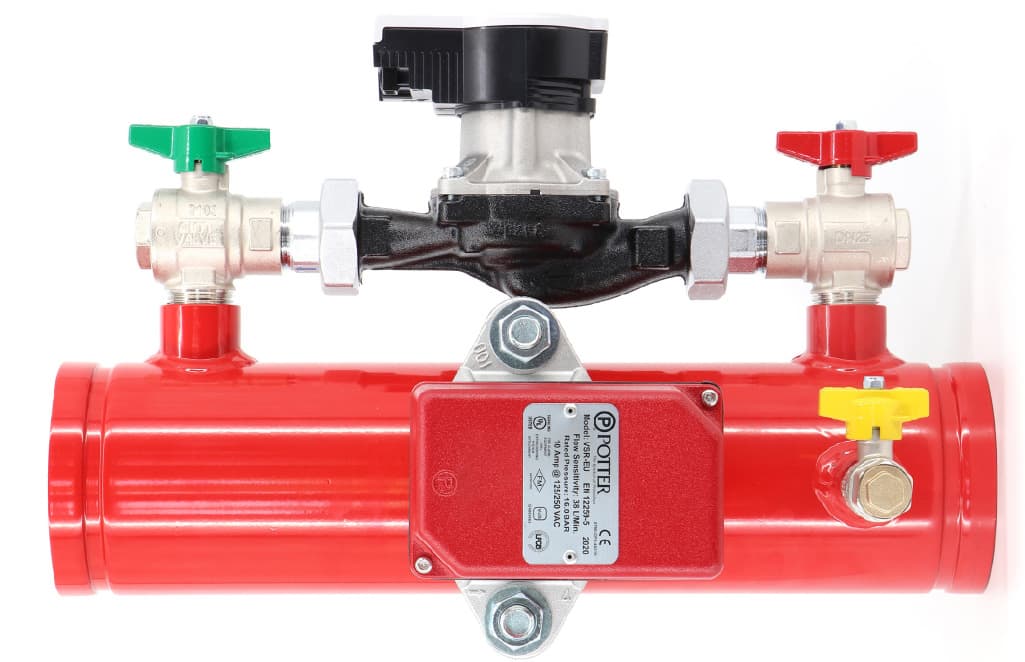
We’re the national distributor for Zonecheck in the U.S., excluding the five boroughs of New York City. Zonecheck is an automatic flow-switch tester that recirculates water inside the pipe around the flow switch, at a rate that simulates a single sprinkler head. The switch sees moving water, so it’s tested without opening a drain and without sending water out of the system. Testing is run from a key switch, which means it can be done from a convenient location. Zonecheck units are offered in sizes from 2 to 8 inches, and the manufacturer lists them as UL and FM Approvals listed.
There are two ways to bring it into a building. The original Zonecheck suits new installations, and the Zonecheck Retro-Fit is designed to fit around an existing flow switch. You can compare the models on the Zonecheck product page or the Retro-Fit page. Our drain-free flow switch testing article covers the fire pump and corrosion benefits in more detail.
What Should You Gather Before Evaluating a No-Discharge Option?
A good conversation with a contractor or with us starts with specifics. Have these ready:
- The number of flow switches and the pipe size at each
- Whether you’re replacing a switch, adding one, or working around an existing one
- Where the current test drain is, and what problems it causes
- Whether the system includes a fire pump
- How your monitoring company handles test notifications
- What your AHJ or insurer expects for testing procedure and records
That list tells us quickly whether the original or the Retro-Fit is the right starting point, and where a site visit is needed.
Does a No-Discharge Test Change Your Compliance Obligations?
No. Zonecheck supports the flow-switch test. It doesn’t replace required inspection, testing, documentation, or the judgment of qualified fire protection professionals. Confirm your procedure and recordkeeping with your AHJ and your fire protection contractor before changing methods.
Frequently Asked Questions
Where does the water go during a traditional flow test?
It depends on how the system was piped. Common discharge points include a floor drain, a sink, or an outside outlet. The crew should confirm the location and make sure it can handle the flow before the test starts, since an undersized or hard-to-reach drain is what turns a routine test into a cleanup job.
How often are waterflow alarm devices tested?
Many jurisdictions follow NFPA 25, which sets intervals by device type. Mechanical waterflow alarm devices are commonly tested quarterly. The edition adopted locally, and your AHJ determines the actual schedule, so confirm it with your fire protection contractor.
Can an existing flow switch be tested without discharge?
The Zonecheck Retro-Fit is designed to fit around an existing flow switch. Whether it works for a given system depends on pipe size, layout, and installation requirements, so a contractor should review the setup first.
Should the monitoring company be told before a flow test?
For any test that sends an alarm signal, generally yes. A test signal can look like a real event at the monitoring station, so teams notify the company beforehand and confirm the signal afterward. Follow the process your contractor and monitoring provider already use.
Is a no-discharge test a good fit for every building?
Not automatically. Fit depends on the system layout, switch and pipe size, installation access, and local requirements. Contact Zonecheck USA with your building details, and we’ll help you work out whether the original system or the Retro-Fit makes sense.